
Five mornings a week, Mark Wimbish and Cindy Wimbish pass my front kitchen window. Side by side in their wide-brimmed hats, they keep pace with each other.
I've lived next door to them for nineteen years. My husband has known them far longer; he grew up in the house we live in now. They've always been part of the landscape of our lives, offering a neighborly hello or an annual gift of Oak Glen apple cider, my husband's favorite.
And five mornings a week, they walk. Two miles or a little more. Monday through Friday.
They have seven routes through our Huntington Beach neighborhood, carefully plotted by Cindy so the scenery doesn't become too monotonous. Their ritual begins after the 6:45 alarm and a check of the weather where their children live. They stretch, collect the newspaper, and go. Cindy listens to an audiobook as they walk. Mark simply appreciates his wife's company.
They've been doing this for at least ten years, probably longer. They ponder, then quickly dismiss the idea of cutting back.
"You keep going for your health and to keep yourself active."
It took me an embarrassingly long time to realize I might be watching a Senior Success story walk right past my house.
I knew them. But I didn't really know them.
That was about to change.
When I enter their immaculately tidy home, Mark immediately apologizes that Cindy is on the phone handling the details of her late sister's estate. No matter. He sweeps me toward a collection of figurines displayed in the corner of their living room.
The sculptures belonged to Cindy's mother, who continued creating art well into her nineties. In fact, she was working on one piece she had decided wasn't up to her standards when she missed her stool, fell, and fractured her femur.
Fortunately, she had her phone and called 911. But when the EMTs arrived, she had one demand before she would let them near her.
"Before you touch me, you take that glass dome and cover up my clay. I don't want it to get dry."
They apparently thought she was confused.
She was not.
"You don't touch me. You take care of that first."
At the hospital, she was told she might never walk again.
"I will walk," she replied.
And she did.
Cindy's mother lived to 103, remaining fiercely independent well past 100. When she was diagnosed with colon cancer near the end of her life, she declined treatment with similar resolve.
"Everybody's got to die of something."
By now Cindy has joined us. She wryly notes that whatever artistic talent ran through the family seems to have stopped before reaching her. As a child, she and her siblings were once given lumps of clay. Her brother fashioned a cute little dog.
When her mother asked what Cindy was making, she answered:
"I'm making a floor."
There was plenty of creative talent elsewhere in the family. Cindy's father, who lived to 95, built an elaborate scale model of the Mayflower, complete with sails made by her mother.
"We are Mayflower descendants," Cindy announces, leading me to a framed record of their lineage through William Brewster.
Unexpectedly, we've found something else we have in common. I'm a Mayflower descendant, too. Later that day, I text Cindy my own documentation. Different family line.
Her response arrives shortly afterward:
"Well, it looks like we are Mayflower sisters."
Family is everywhere in this house. Portraits chronicle three sons and six grandchildren, along with years of shared vacations Mark and Cindy organized to keep everyone connected. Alaska. Cape Cod. Costa Rica. Hawaii. Yosemite. The Oregon coast. As the grandchildren have grown, coordinating everyone has become harder, but the desire to gather them hasn't disappeared.
Nor has the traveling. Mark and Cindy still make their way to their grandchildren's events and milestones whenever they can.
Their history with our family stretches back much further than mine. They remember my husband as a kid performing magic in their living room, and years later, building elaborate haunted houses in the driveway. I married into those memories. They knew pieces of his childhood I didn't.
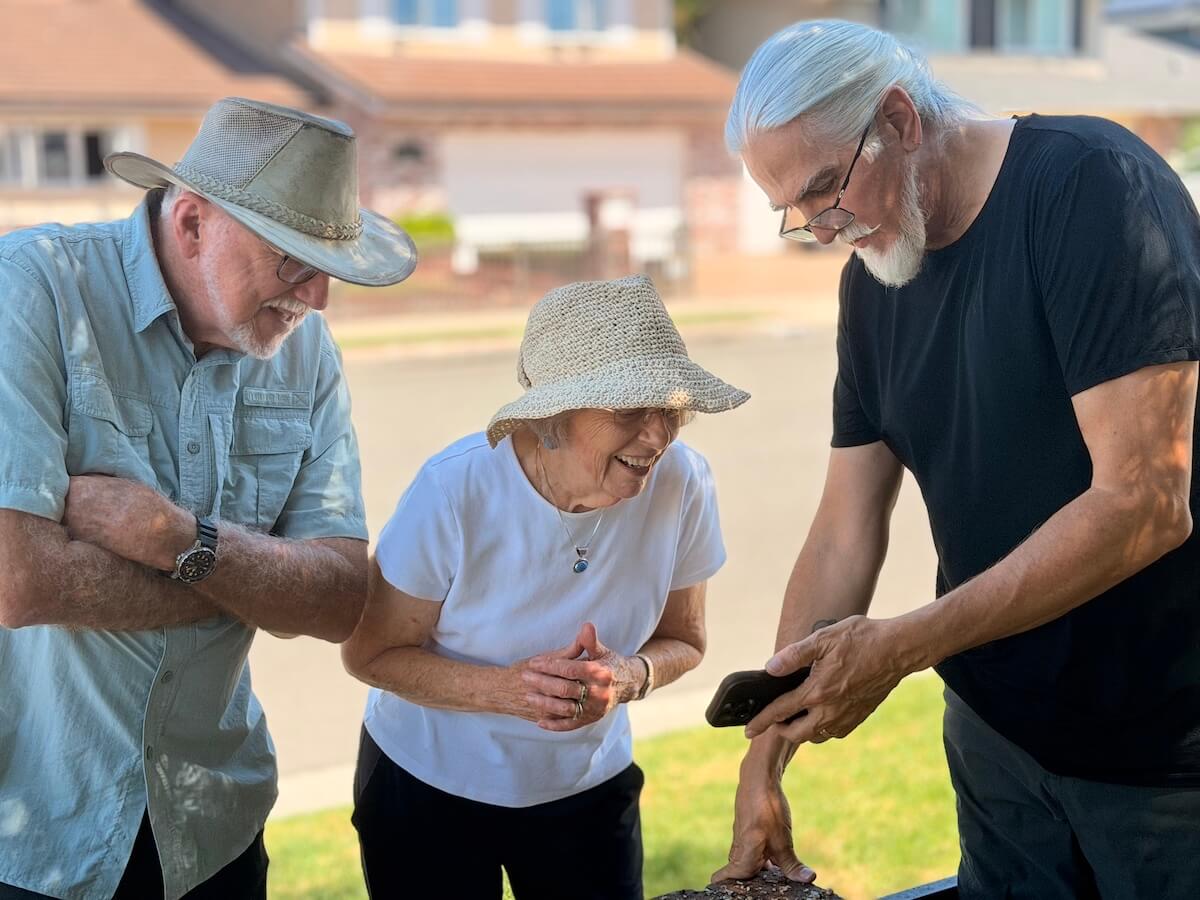
Eventually, I ask how the two of them began.
Cindy, 82, and Mark, who will soon be 82, met at Pepperdine College in the early 1960s. Mark arrived on a journalism scholarship and found Cindy in one of his English classes.
"I thought she had the sexiest eyes I'd ever seen," he recalls.
Then comes the correction, with a smile and a twinkle.
"Turns out she just didn't see well. Or she would have noticed me."
Eventually, the smell of a cake being baked in Cindy's dorm gave Mark an excuse to strike up a conversation. Bible study led to dates. Dates led to an understanding that apparently made a formal proposal unnecessary.
This past April, they celebrated sixty years of marriage.
Mark has his own theory about their success.
"The way to a successful marriage is the wife takes care of all the finances."
My husband would heartily agree.
Mark's family history doesn't offer quite the same promise of longevity as Cindy's. His father died at 66 and his older brother at 53. Mark has dealt with hypertension since he was young, takes multiple medications, and eventually underwent back surgery after problems with his sciatic nerve.
Yet here he is, approaching 82 and still walking more than ten miles most weeks.
"I've outlived my own expectancy," he says.
Retirement has also given him time for pursuits that are considerably less strenuous.
Mark makes jam.
Lots of it.
Blackberry. Boysenberry. Key lime. Strawberry. Raspberry. Cherry. Apricot, his favorite.
What began with blackberry cuttings from a friend's backyard evolved into a hobby built partly around the pleasure of giving the jars away. It also connects him to another generation. His mother and grandmother spent years making pomegranate jelly together from the trees outside his grandmother's home.
Mark also still fishes with his sons. But he notes he's not as fit as he used to be. Now, when Mark's son Tim ties a tiny fly onto the line because Mark can no longer see well enough to do it, Tim reminds him:
“Dad, you did this for me. Now, it's my turn to do it for you.”
Small things, perhaps. But I'm beginning to suspect small things are where the Wimbish story lives.
Saturday is the exception. Out of sixty years together, and especially because of COVID, when every day looked the same, Mark and Cindy Wimbish have deliberately created a Saturday that feels different. That means they can sleep in until 7:30.
They take their morning coffee ritual up a notch and have flavored amaretto. Cindy adds whipped cream to hers. Biscotti to the side. If she can, she'll stay in her pajamas and set herself to the challenge of a 300-piece puzzle. The night before, they stay up to 11 pm like rebels.
Their routines may be settled, but Cindy's working life isn't quite finished.
Cindy's father opened Orangeland RV Park in 1972 as a family business, preserving many of the citrus trees from the grove that once occupied the land. Cindy joined the staff in 1985 and gradually worked her way to the top. Her father once told her, “We'll never be as good as you.”
At 82, she is still Chairman of the Board and is now overseeing the sale of the 195-site property. She's also helping create a family LLC designed to carry what her parents built forward to their grandchildren and great-grandchildren.
Retirement?
“I don't want to retire.”
In addition to teaching Bible study to the children and a women's study group at their church, she wants to volunteer her time even further with the homeless kids here in Huntington Beach.
“If there are young people that still have hope of becoming something, but they're in these lousy situations or homeless, I want to give them every benefit of the doubt.”
For sixty years of marriage, Cindy says it's commitment, patience, and staying through the difficult parts that matter. Mark talks about love and companionship. When pressed, he responds:
“She's just with me.”
Their instinct to show up hasn't disappeared. When another neighbor objected to my son's afternoon drum practice, both Mark and Cindy Wimbish defended him. He was a kid learning an instrument, they reasoned. Let him play.
Cindy sits with Mark while he watches sports she doesn't particularly care about. He wants her home when she goes somewhere. She wants to travel; he'd probably rather stay home with his berry patch. He loves Monty Python. She thinks they're stupid.
Sixty years leaves plenty of time to discover exactly how another person can irritate you.
It also leaves plenty of time to learn how to keep showing up.
Five mornings a week, sometime after 6:45, Mark and Cindy put on their wide-brimmed hats and leave the house next door.
They choose one of seven routes.
And they walk.